
Technology Education
The Technology Education (TEED) program is a partnership between NJIT and Rutgers University, Newark, offering a degree in Engineering Technology and an instructional certification with the Teacher of Technology Education (1810) endorsement.
About the Program
The greatest current need of U.S. education is for highly qualified teachers of science and technology at the secondary school level. According to the U.S. Bureau of Labor Statistics, the shortage will intensify over the next decade as teachers of the “baby boom” generation retire. Technology-savvy teachers who are able to incorporate newly-developing educational methodologies and technologies into the curriculum are also in high demand.
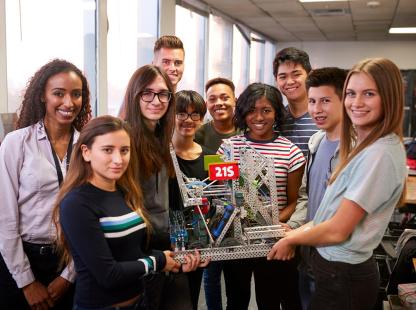
Technology teachers teach problem-based learning utilizing math, science and technology principles. Technological studies involve students:
- Designing, developing, and utilizing technological systems such as communication, transportation, manufacturing, and construction technologies.
- Performing open-ended, problem-based design activities.
- Learning cognitive, manipulative, and affective learning strategies.
- Applying technological knowledge and processes to real world experiences using up-to-date resources.
- Working individually as well as in a team to solve problems (International Technology Education Association Standards).
Students may enter this program as a freshman, or transfer into this program from an Engineering Technology or Pre-Engineering program at a two year college. The program consists of 120 credits, with over 37 credits of education at Rutgers University, Newark, including one semester of student teaching. This program will cover material in a variety of Engineering Technology disciplines and utilize the NJIT Makerspace.
Candidates for a teacher-education certificate must have a 2.8 cumulative grade point average to successfully complete their teacher education program. They also must pass the appropriate PRAXIS examination before the New Jersey State Department of Education will issue the appropriate certificate.
Coordinator
Dr. Samuel Lieber
Telephone: 973.596.6368
Email: samuel.lieber@njit.edu
Important Links
- Program of Study
- Course Descriptions and Syllabi
- Academic Advising
- SAET Student Information